Isochronic tones and binaural beats are the two major brainwave entrainments currently available.
They both work using sound frequencies which either slow down the brain activity or speed it up.
However, you might be wondering how they function and which is better.
Besides, you want to discover which is most suitable for you and which tone will provide you with the best results.
Binaural beats and isochronic tones are brain wave entrainment technologies. Binaural beats send two separate frequencies to each ear, and your brain forms a third tone. Whereas isochronic tones use one tone, the beat is turned on and off, creating a pulsing effect.
This article will explore the differences between these two technologies, which in turn will help you decide which is most suitable for your needs and your ears.
Isochronic tones vs binaural beats – key takeaways:
Binaural beats = two slightly different tones, one in each ear. Your brain “hears” the difference as a beat. Headphones are required.
Isochronic tones = one tone switched on and off at a steady rate. No headphones needed – they work through speakers.
Binaural beats have more research behind them and suit relaxation, meditation and sleep (delta, theta, alpha).
Isochronic tones produce a stronger, sharper rhythm and are popular for focus and energy (alpha, beta, gamma).
Neither is a medical treatment. Results vary from person to person, so testing both is the best way to find out what works for you.
Suppose you are looking to enhance your brain capacity and improve your meditative state.
In that case, you will undoubtedly benefit from the many brain entrainment technologies currently being used by millions of people.
Isochronic tones and binaural beats are two of the most popular and have been scientifically investigated and examined.
It opens up brand-new avenues for people to get their brain wave synced to a more meditative, relaxed, and high-performance state.
These sounds are providing incredible opportunities for people to experience various brain wave states.
It purportedly provides more ease and swiftness than just regular meditation.
This meditation is an assisted approach that helps you achieve a meditative state, which seems elusive and out of reach for most people in the modern world.
But what’s the difference between isochronic tones and binaural beats, and how do they exactly work?
What Is Brainwave Entrainment?
Brainwave entrainment is the idea that a steady, repeating rhythm (sound or light) can nudge your brain’s electrical activity to follow the same rhythm. Scientists call this the frequency following response or, for steady sound pulses, the auditory steady-state response (ASSR). Binaural beats, isochronic tones and monaural beats are the three main audio methods used to create that rhythm.
Binaural vs Isochronic: Quick Comparison
Feature
Binaural Beats
Isochronic Tones
How it works
Two different tones, one per ear; the brain perceives the difference as a beat
One tone switched on and off at regular intervals
Headphones
Required
Not required (speakers work)
Where the beat is created
Inside the brain (brainstem)
In the audio itself
Sound
Soft, smooth, gentle hum
Sharp, distinct pulsing
Strongest for
Sleep, meditation, relaxation, anxiety relief
Focus, energy, alertness, studying
Scientific research
Dozens of studies and meta-analyses (mixed results)
Limited research
Group listening
No
Yes
Best for beginners?
Yes – easier to listen to
Takes time to get used to
What Are Binaural Beats And How They Work
Binaural beats meaning: “binaural” simply means “with two ears”. A binaural beat is an auditory illusion – a beat that does not exist in the recording itself but is created by your brain when each ear hears a slightly different tone.
Binaural beats work by sending different hertz frequencies to the left ear and right ear. When you hear two frequencies simultaneously, the brain efficiently creates a third tone with a mathematical difference.This difference in tones creates the binaural beat in hertz.For example,
if a 200 Hz frequency is entering the left ear and a 210 Hz is placed in the right ear, the brain will process these frequencies and create a third frequency of 10 Hz.
The brain then produces brain waves at a comparable hertz for both the left ear and right ear.
The term for this phenomenon is frequency following response.
The effect was first described by the Prussian physicist Heinrich Wilhelm Dove in 1839 and became widely known after Dr Gerald Oster’s 1973 article “Auditory Beats in the Brain” in Scientific American. For the effect to work well, the base (carrier) tones are usually kept below about 1,000 Hz and the difference between them under about 30 Hz.
The binaural beat is still the most popular and is the most used.
When it comes to the brain wave entrainment market, for years, it has a firm hold.
The binaural beat is low cost, reliable, and proven to be effective in many studies.
As a result, binaural beats are known to be the preferred form in the market for brainwave entrainment.
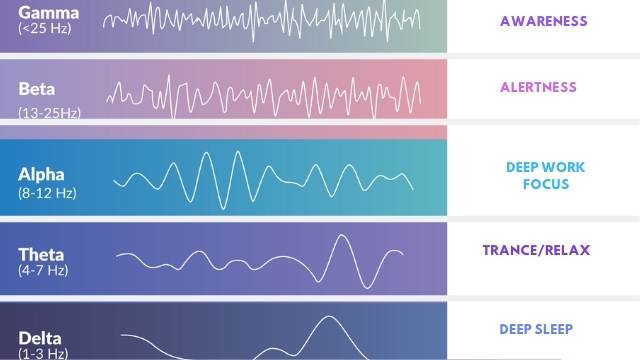
Each frequency does something unique to the brain.
The lower the Hz, the slower your brain will vibrate and the faster the Hz, the more active your brain operates.
Each tone or frequency is designed to accompany a specific task or activity. The selected binaural beat can keep your mind focused on that task for more extended periods.
BINAURAL BEAT
Brain State
Activity
Delta (0.5Hz-4Hz)
Deep, dreamless sleep
Deep Sleep, lucid dreaming
Theta (4Hz-8Hz)
Drowsy, deeply relaxed, “twilight” state
Meditation, visualisation, relaxation
Alpha (8Hz-12Hz)
Calm, relaxed alertness
Studying, reading or learning
Beta (13Hz-30Hz)
Active, alert thinking
Deep focused work, memory, retention
Gamma (30Hz+)
High-level information processing
Peak performance
Advantages And Disadvantages Of Binaural Beats
Advantages of Binaural Beats
Disadvantages of Binaural Beats
Efficient in numerous studies
Requires headphones for you to feel the full effect
Technology has been around for decades
Ear irritation if you fall asleep with earphones in
Extremely accessible with hundreds of choices
Plenty of poor-quality audios from amateur producers
The beats are affordable
Could be a problem if you have epilepsy
Gentle sound that is easy to listen to for long sessions
Weaker effect at higher (gamma) frequencies
If you’re interested in exploring exactly what activities you should do when listening to binaural beats at each frequency and how to maximise the benefit, watch this video on my YouTube channel for free.
What Are Isochronic Tones And How They Work
Define isochronic: the word comes from the Greek isos (“equal”) and chronos (“time”) and means “occurring at equal time intervals”. So isochronic tones (also called isochronic beats) are sound pulses that repeat at perfectly even intervals.
Isochronic tones only use one tone. The single tone is repeatedly turned on and off, creating a pattern similar to a pulse. The speed will depend on the frequencies utilised. Isochronic tones are a new form of brain wave entrainment when it comes to popularity online, but the theory behind it is similar to binaural beats. For example, a 10 Hz isochronic tone is a single tone that switches on and off 10 times every second. Because the beat is already in the sound, your brain does not need to “build” it – it simply responds to the rhythm it hears.
In binaural beats, two tones are utilised, which are played into each ear.
In contrast, the isochronic tone will tend to be jarring to the ears.
As a result, they aren’t exactly easy listening, and this fact turns many people off.
Although this may seem like a minor distinction, the result is you don’t have to utilise headphones.
For some who are into brain entrainment technology, this is exciting.
However, not everyone wants to use headphones, especially if they require focused tones while working or at home.
Therefore, isochronic tones are the ideal choice.
Although, there aren’t many scientific pieces of evidence to back it up.
Isochronic tones are not as efficient for entrainment when set at lower levels, such as the delta and theta range.
This suggests that if you want to get your mind into a trance state for meditation, visualisation or deep sleep, then isochronic tones won’t be as effective as binaural beats.
Nevertheless, users recommend them at higher ranges, such as Alpha or Beta, and say they work on par with binaural beats in the more active frequency levels.
Moreover, they don’t need to use headphones to get into this state, meaning you can play them in the background and have a deep workflow.
But as mentioned, the sound is something you have to adapt to, and it may not be for everyone.
Another issue is you are required to be near the speakers within 5 meters.
If not, the effects may not be as intense.
You must also consider your situation if you are at work or at home with a noisy family. It is crucial to block outside noise when you are using brainwave entrainment.
So, in the end, you might have to use your headphones to hear it.
Isochronic Tones vs Monaural Beats
You may also come across monaural beats. Here, two tones are mixed together before they reach your ears, so the beat is heard through both ears and through speakers. Like isochronic tones, monaural beats don’t need headphones, but their pulse is softer and less distinct. Isochronic tones have the sharpest, most clearly defined rhythm of the three methods.
Advantages And Disadvantages Of Isochronic Tones
Advantages of Isochronic Tones
Disadvantages of Isochronic Tones
It does not require headphones
The tones must be audible in the recording for ideal entrainment
You can listen with a group
Sounds may be jarring compared to binaural beats
Some will find the effects intense
Not as effective in the lower frequency ranges such as theta and delta
Fresh and innovative sounds.
Not enough peer-reviewed research studies to back up its efficiency
Works for people who hear differently in each ear
Pulsing can be distracting during sleep
Isochronic Tones Benefits
Most of the reported isochronic tones benefits come from users and small studies, so treat them as possibilities rather than guarantees. People most often use isochronic tones for:
Focus and concentration – beta (13–30 Hz) isochronic tones are a popular background sound for work, studying and deep work sessions.
Energy and alertness – higher beta and gamma pulses can feel stimulating, like a “mental coffee”.
Calm, relaxed attention – alpha (8–12 Hz) tones can help you settle into reading, learning or light meditation.
Memory and learning – some users pair alpha or gamma isochronic tones with study sessions.
Listening without headphones – useful for yoga classes, group meditation or working in an office with speakers.
Getting past “headphone fatigue” – you can listen for longer without anything in or on your ears.
Isochronic Tones For Focus
For focus, start with an alpha tone around 10 Hz for calm, steady attention, or a beta tone around 14–18 Hz for more demanding analytical work. Keep the volume low – just loud enough to hear the pulse – and listen for 20–45 minutes while you work on a single task.
Isochronic Tones For Sleep
Isochronic tones for sleep are usually set in the delta (0.5–4 Hz) or theta (4–8 Hz) range. However, as mentioned above, the sharp pulsing sound can keep some people awake, and isochronic tones seem weaker at these low frequencies. If you want help falling asleep, binaural beats or soft monaural beats are usually the better choice. If you prefer isochronic tones, choose a recording with a gentle fade-out and background music.
Which Is Better Binaural Beats Or Isochronic Tones?
In general, binaural beats are better because they have been scientifically studied for years and are readily available. In addition, isochronic tones in the range of Alpha to Gamma are effective without headphones, but binaural beats provide you with a full spectrum of frequencies, making them the most popular option.
Binaural beats are incredible for focusing, meditating, stress relief, and they have a proven track record in these areas.
They are also ideal if you are not bothered about wearing headphones because they help block out your environment and assist with focusing on the task.
Binaural beats can be used to imprint subliminal messaging into your subconscious mind, and they are easy to create and personalise
Therefore, if I had the choice between binaural beats and isochronic tones, I would select binaural beats.
The flexibility of binaural beats in each frequency and the multiple investigations have demonstrated that binaural beats are incredibly effective at influencing your brain waves.
Choose Binaural Beats If You…
Want help with sleep, meditation, visualisation or relaxation
Prefer a soft, soothing sound
Don’t mind wearing headphones
Want the option with the most research behind it
Are new to brainwave entrainment
Choose Isochronic Tones If You…
Want help with focus, energy and alertness
Don’t like or can’t use headphones
Want to listen with a group or through speakers
Have uneven hearing between your ears
Find binaural beats too subtle to notice
Do Binaural Beats And Isochronic Tones Really Work?
On average, binaural beats and isochronic tones provide the user with many benefits like sleep, meditation, deep focused work and improved memory. But few scientific studies have been completed on binaural beats and even fewer on isochronic tones, but frequent users state they work incredibly well.
Are Binaural Beats Scientifically Proven?
Partly. A 2019 meta-analysis of 22 studies (Garcia-Argibay et al., Psychological Research) found that binaural beats had a small-to-medium positive effect on memory, attention, anxiety and pain perception. However, a 2023 systematic review (Ingendoh et al., PLOS ONE) found that studies measuring brain activity with EEG gave inconsistent results – some showed entrainment, others didn’t. In short: binaural beats appear to help many people feel calmer and more focused, but scientists still debate exactly why.
Do Isochronic Tones Work?
There is much less research on isochronic tones specifically. What we do know is that the brain clearly responds to steady, rhythmic sound pulses – this is the auditory steady-state response, which is strongest at around 40 Hz (gamma). That supports the idea behind isochronic beats, but there are not yet enough high-quality studies to say how well they work for sleep, focus or anxiety. Most evidence is still user experience.
After everything is said and done, brainwave entrainment is all about being experimental.
You may come across some sounds and recordings that don’t suit you and others you would be hooked in and can’t live without.
Because of this, you need to know what is best for you and try to discover beats by browsing through catalogues based on your preferences.
It doesn’t matter what type of technology was utilised to create the music.
Some people gravitate towards binaural beats and are completely turned off by the sound of Isochronic tones.
Other people experience a genuine high out of Isochronic tones, especially at the high-frequency ranges.
Perhaps you can try binaural beats for relaxing, focusing, sleeping, as well as pain relief.
For energy and memory enhancement and high-level wakefulness, maybe you can experiment with the frequency range of Isochronic tones. It is all up to you.
If you are just exploring the world of brain entrainment technology, binaural beats are a good entry point.
That being said, with any music, your experience will be dependent on what you hear, so make sure you purchase something that is professionally produced.
Can You Use Binaural Beats And Isochronic Tones At The Same Time?
Yes. Many producers layer binaural and isochronic beats in one track, usually set to the same target frequency (for example, both at 10 Hz). The idea is that the isochronic pulse strengthens the rhythm while the binaural beat adds a smoother, deeper effect. Some recordings also add a third layer – spoken or silent affirmations – to create subliminal meditation with isochronic and binaural tones.
A few tips if you try combined tracks:
Make sure both layers target the same frequency – mixing, say, a theta binaural beat with a beta isochronic tone sends mixed signals.
Still use headphones, otherwise you lose the binaural part.
Keep the volume low and stop if you feel a headache or discomfort.
Most Effective Binaural Beats And Isochronic Tones By Goal
There is no single “best brainwave entrainment” track for everyone. The most effective binaural beat or isochronic tone depends on what you want to achieve:
Goal
Frequency
Best Option
Deep sleep
1–3 Hz (Delta)
Binaural beats
Meditation & visualisation
4–7 Hz (Theta)
Binaural beats
Stress & anxiety relief
6–10 Hz (Theta/Alpha)
Binaural beats
Relaxed learning & reading
10 Hz (Alpha)
Either
Focus & productivity
14–18 Hz (Beta)
Isochronic tones
Energy & alertness
18–25 Hz (High Beta)
Isochronic tones
Peak performance & memory
40 Hz (Gamma)
Isochronic tones
How To Listen Safely And Get The Best Results
Pick one goal per session – sleep, focus or meditation – and choose the matching frequency.
Use good stereo headphones for binaural beats; speakers or headphones are fine for isochronic tones.
Keep the volume low. The tones don’t need to be loud to work.
Listen for 15–30 minutes to start, then build up to 30–60 minutes.
Reduce distractions – sit or lie down, close your eyes for meditation, or close other tabs for focus work.
Be consistent. Use the same type of track daily for 1–2 weeks before judging the results.
Never listen while driving or operating machinery, especially to delta and theta frequencies.
Talk to your doctor first if you have epilepsy, a seizure disorder, a heart condition or a pacemaker.
Frequently Asked Questions
What is the difference between isochronic tones and binaural beats?
Binaural beats play two slightly different tones, one in each ear, and your brain creates the beat. Isochronic tones use a single tone that switches on and off, so the beat is already in the sound. That is why binaural beats need headphones and isochronic tones do not.
What are isochronic tones?
Isochronic tones are evenly spaced pulses of a single tone, used for brainwave entrainment. The rate of the pulses (for example, 10 pulses per second = 10 Hz) is the frequency your brain is encouraged to follow.
Do isochronic tones work?
The brain does respond to rhythmic sound pulses, and many users report better focus and energy. However, there is still little peer-reviewed research on isochronic tones specifically, so results are not guaranteed.
Are binaural beats effective?
Research suggests binaural beats can have a small-to-medium effect on anxiety, attention, memory and pain perception, though studies on brainwave changes are mixed. Many people find them helpful for relaxation, meditation and sleep.
Do you need headphones for isochronic tones?
No. Isochronic tones work through speakers because the pulse is built into the sound. Headphones can still help if you are in a noisy place.
Which is better for sleep: binaural beats or isochronic tones?
Binaural beats are usually better for sleep. Their sound is softer, and they tend to work better at the low delta and theta frequencies linked with sleep and deep relaxation.
Which is better for focus: binaural beats or isochronic tones?
Both can help, but many people prefer isochronic tones in the alpha and beta range for focus because the pulse is more noticeable and they can play through speakers while working.
Can you listen to binaural beats and isochronic tones at the same time?
Yes. Many tracks combine both at the same target frequency. Use headphones so you still get the binaural effect.
Are isochronic tones safe?
For most healthy adults, yes, when played at a low volume. People with epilepsy or a history of seizures should avoid rhythmic audio stimulation unless their doctor approves it, and you should never listen while driving.
Takeaway
The modern world is demanding and hectic, and you need all the help you can get.
Brain entrainment technology has been around the block for years, but it may be a new sound to you.
In the isochronic tones vs binaural beats debate, there is no wrong choice: start with binaural beats for sleep, meditation and relaxation, and try isochronic tones when you want focus and energy without headphones.
Explore these amazing frequencies for your ears and experience states of consciousness you’ve never felt before.

One thought on “Isochronic Tones or Binaural Beats: Key Differences and Which to Choose?”